Updates on programming will be found here…
Updated 9/01/2026 – Lots going on!
Working on a project from Texas – Self Harm Prevention w/ a resident incarcerated in Texas
Working on a project from North Carolina – Gun Violence & Restorative Justice
Starting to record Season 6 of the Prison POD next week! Already have 10 guests lined up.
Just submitted Season 5 of the PrisonPOD to Edovo to be uploaded onto the prison tablets
Still looking for Sponsors for Season 6
Updated 7/30/26
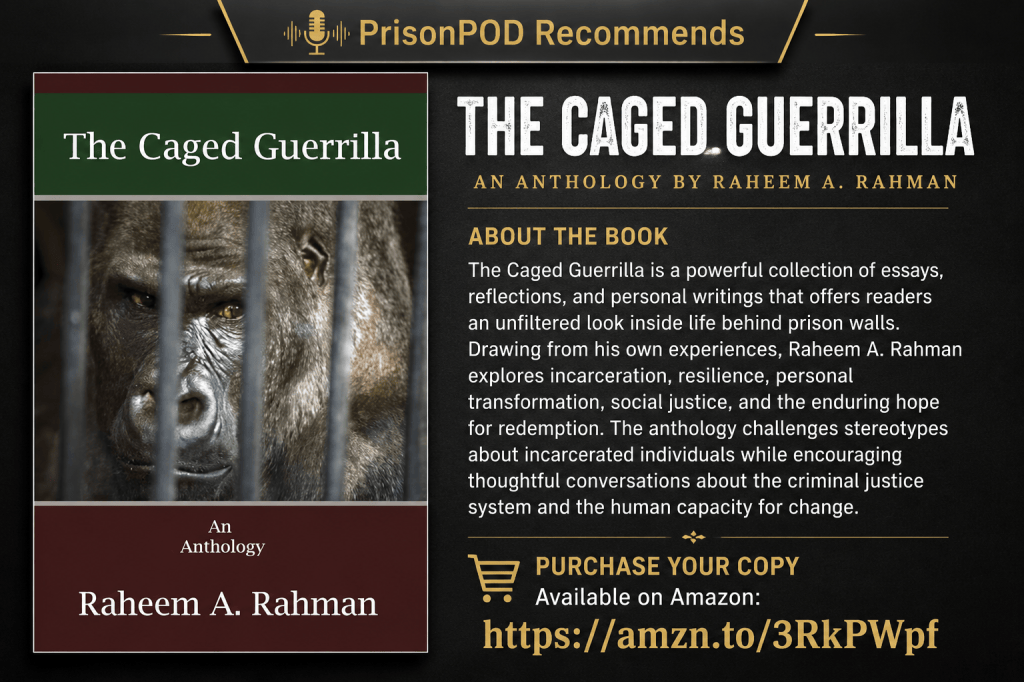
Lots happening! Right now I am working on Book Ads to run during the podcasts. I would like to feature a book or program available in prisons each episode. Below is a sample; these have audio added on the podcasts and YouTube. These will be available on YouTube
Scheduling for Season 6 – Still need SPONSORS!
Updated 6/30/26
Find out more: CORRIO
Season 6 – Will begin recording in September 2026

Attention: For the month of April 2026 Corrio will match all donations up to $1000.
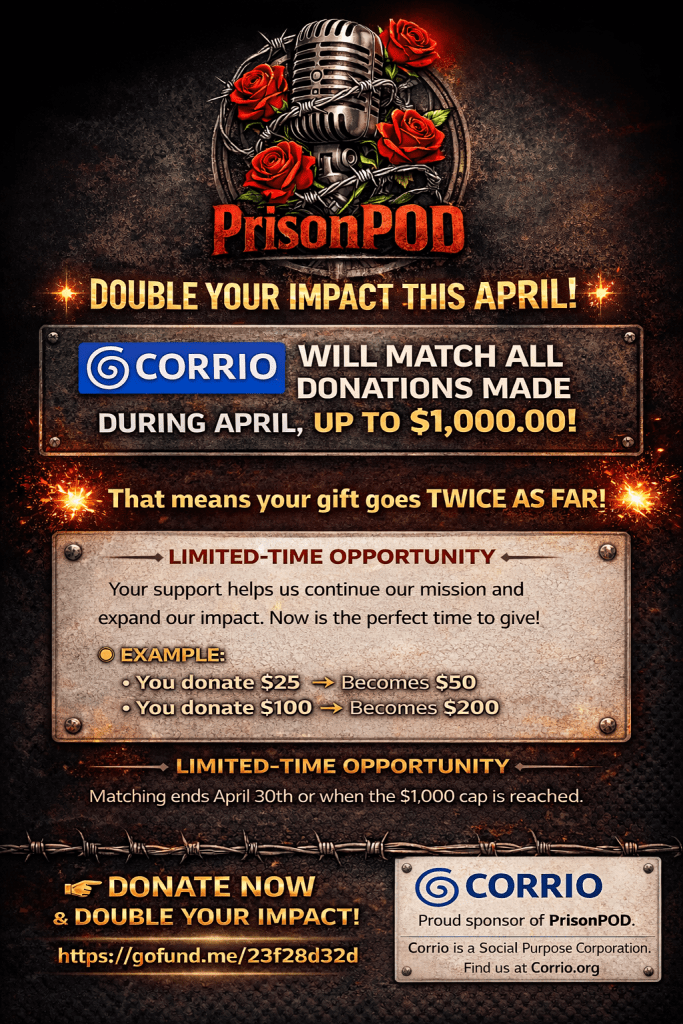
Season 5 Sponsor CORRIO , please visit their website to find out more about the voice messaging service offered for those who are incarcerated and their families.

April 9, 2026 – Season 5 of the PrisonPOD is releasing new episodes each Tuesday on YouTube Through May.
Audio Only podcast is releasing new episodes every Monday on Buzzsprout
This months booklist:
Books currently on my desk…
Going to Prison – Steven Matthew Clark & Dr. Ron Garrett
Reformation 319 – Jason Zaharis
Trauma Unraveled – Keith E.Erickson
Five Minutes To Count – Lisa A. Purtue
San Quentin Exodus – Bill Smoot
Tears We Can’t Ignore – Christopher Deon Gattis
The Prison Wives Bible – Jessica San Luis & Phillip A. Jones, Jr.
Mother Love – Jean Trounstine
*************************************************************************
Season 5 dropped on Tuesday January 13th, 2026 –
In this episode of the Prison Pod, host Valerie Cartonio speaks with Percy H. Pitzer, a retired warden and founder of the Pitzer Family Education Foundation. They discuss the importance of education in reducing recidivism, the role of inmates in supporting educational initiatives, and the need for community engagement in the rehabilitation process. Percy shares his experiences in the correctional system and emphasizes the necessity of common sense in sentencing and rehabilitation. The conversation highlights the foundation’s efforts to support children of incarcerated parents and the importance of expunging criminal records to aid reintegration into society.
In this episode of the Prison Pod, Valerie Cartonio interviews Madinah Wilson-Anton, a Delaware state representative and comedian. They discuss Madinah’s advocacy for social justice, her experiences with vitiligo, and the importance of humor in addressing serious topics. Madinah shares her journey in politics, the significance of community engagement, and the role of faith and hope in her work. The conversation also touches on the value of extended families, inspiring books, and the motivations that drive Madinah to make a difference in her community.
In this conversation, Valerie Cartonio interviews John R. Whitman about the Creative Prisons Project, which aims to harness the creative potential of incarcerated individuals. They discuss the challenges of copyright registration for prisoners, the therapeutic benefits of art, and the vast untapped creativity within the prison population. Whitman emphasizes the importance of creativity in rehabilitation and the need for societal change to address poverty as a root cause of incarceration. The conversation highlights the potential for art and creativity to transform lives and improve prison environments.
Kara Janssen is formerly incarcerated and works on prison reentry and reform. she is a storyteller and teaches others how to tell their story. Only you can tell your own story from your perspective. Kara’s Linked In: We Stand AZ: https://www.alignable.com/glendale-az… We Stand AZ is “a community-rooted nonprofit dedicated to empowering incarcerated individuals and their loved ones to become powerful advocates for change.”
PrisonPOD would like to thank their Sponsor – CorrioSPC – Corrio helps inmates connect with their loved ones by allowing an inmate to receive and leave messages at any time using standard prison phones. – https://corriospc.org
In this episode of the PrisonPod, host Valerie Cartonio speaks with Sobanan Narenthiran, who shares his transformative journey from aspiring doctor to incarcerated individual. Sobanan discusses the impact of his prison experience on his identity, the educational opportunities available in prison, and how he found hope and purpose during his time behind bars. He addresses misconceptions about prisoners, the importance of second chances, and the role of spirituality in personal growth. Sobanan also shares insights about his current work in social enterprise and his upcoming book, emphasizing the need for systemic change in the criminal justice system. Break Through Enterprise
Samuel talks about the work of Youth Love & Above – In this episode of the Prison Pod, Valerie Cartonio interviews Samuel Hunter, founder of Youth Love and Above, a program aimed at rehabilitating youth and preventing them from entering the prison system. Samuel shares his personal journey from incarceration to creating impactful programs that focus on cognitive restructuring and community outreach. The conversation emphasizes the importance of listening to youth, the spiritual foundations of the program, and the need for community support to break down barriers and foster understanding among diverse groups.
In this episode of the Prison Pod, Dr. Robert Mossi Alexander discusses his journey from incarceration to becoming an educator and filmmaker. He emphasizes the transformative power of education in reducing recidivism and shares insights from his documentary ‘Reclaiming Our Humanity.’ Dr. Alexander also highlights the importance of children’s literature in addressing the stigma of incarceration and the need for educational resources in prisons. He shares his collaboration with Edovo to provide educational content on tablets in prisons and recommends several impactful books for those seeking education while incarcerated. Dr. Robert Mossi Alexander is an award-winning documentary filmmaker, educator, and nationally sought-after speaker whose work centers on justice, healing, and human dignity. A proud son of East Oakland, he transformed his lived experiences into a lifelong commitment to uplifting justice-impacted communities. His documentaries Reclaiming Our Humanity and Burning for Justice have screened across the country, sparking powerful conversations on trauma, resilience, and systems change. Dr. Alexander is the Founder of Hood To Higher Ed and Awkwaaba Academics, organizations dedicated to expanding educational access, culturally sustaining pedagogy, and college pathways for system-impacted students. As Counselor/Coordinator for A²MEND at Laney College in Oakland, CA, he empowers Black male scholars through mentorship, leadership development, and culturally responsive support. He has taught inside San Quentin through the Mount Tamalpais College program, presented at universities and national conferences, and partnered with schools, nonprofits, and justice-reform organizations to provide professional development rooted in equity and liberation. A storyteller, educator, and advocate, Dr. Alexander uses film and education to ignite hope, inspire action, and challenge the systems that confine our communities. He believes in the transformative power of voice, culture, and second chances. Website: https://hood2highereducation.com
LinkedIn: @Dr.RobertMossiAlexander
Instagram: @hoodtohighereducation.com
Website: https://hood2highereducation.com
In this episode of The Prison Pod, Valerie Cartonio interviews rap legend X-Rated, who shares his journey from a troubled past to a successful music career. He discusses the importance of family, the meaning behind his album cover, and the themes of perseverance and hope in his lyrics. X-Rated reflects on his spiritual growth, the significance of being a father, and his upcoming autobiography, emphasizing the importance of personal development and inviting others to embrace the light in their lives. Facebook – / xraided1 Instagram – / officialxraided1 TikTok – / officialxraided
In this episode of the Prison Pod, host Valerie Cartonio speaks with Holly Bot, a former inmate who served a 12-year sentence in a Minnesota women’s prison. Holly shares her journey from a troubled life marked by depression and a difficult marriage to finding faith and purpose during her incarceration. She discusses the challenges of adjusting to prison life, the importance of coping mechanisms, and the transformative power of spirituality. Holly also reflects on her experiences with family, the impact of her past on her children, and the significance of second chances in life. Her story is one of resilience, hope, and the desire to help others who are struggling. Her book “From Struggling To Living” (#ad)
In this episode of the Prison Pod, Valerie Cartonio speaks with Mitch Pearlstein about the concept of second chance hiring, addressing the myths and facts surrounding the employment of individuals with criminal records. They discuss the economic and ethical necessity of providing job opportunities to this population, the importance of trades and job training, and the role of education and reentry programs. The conversation also touches on the significance of empathy in hiring practices and the mental health challenges faced by those reentering society. Pearlstein emphasizes the need for better programs and collaboration with outside agencies to support successful reintegration into the workforce.
Book: Second Chance Hiring :An Economic and Ethical Necessity
In this episode of The Prison Pod, host Valerie Cartonio welcomes Sephria Reynolds-Tanner, a criminal justice and drug policy analyst at the Reason Foundation. Sephria shares her journey from working as a probation and parole officer in Washington to her current role, emphasizing the importance of evidence-based practices in criminal justice reform. She discusses the barriers individuals face upon reentry into society, such as the lack of necessary identification documents, and advocates for incorporating lived experiences into policy-making to better support those affected by the justice system. Sephria highlights the need for a shift in focus from punitive measures to supportive resources that facilitate successful reintegration. She passionately argues for the importance of understanding the unique challenges faced by individuals on probation and parole, advocating for policies that prioritize their needs over strict compliance. The conversation also touches on her current projects, including policy briefs on medical marijuana use among probationers and the impact of fines and fees in the criminal justice system, showcasing her commitment to creating a more equitable and effective justice framework. Reason Foundation
Please be advised that this episode has discussions of actual events that occurred in a maximum security prison – Viewer/Listener should use their own discretion. In this episode of the Prison Pod, host Valerie Cartonio speaks with Dr. Karen Gedney, a former prison physician with 30 years of experience in the correctional system. Dr. Gedney shares her journey from being a curious young girl with dreams of becoming a doctor to her unexpected role as a prison doctor, where she faced numerous challenges, including being taken hostage. She discusses her commitment to prison reform and her current work with nonprofits that support the incarcerated population. Dr. Gedney emphasizes the importance of human connection and empathy in the prison system, highlighting programs like the Alternative Violence Project that foster understanding between inmates and the community. Throughout the conversation, Dr. Gedney reflects on her experiences, including the trauma she faced and the support she received from inmates during her recovery. She also discusses her book, “30 Years Behind Bars,” which offers a unique perspective on the prison system through the eyes of a healer. The episode concludes with Dr. Gedney’s plans to launch a podcast titled “Prison Unlocked,” aimed at sharing stories from both sides of the prison experience, emphasizing the need for compassion and understanding in the realm of corrections. “30 years Behind Bars”
Brian Koehn – Social Purpose Corrections In this episode of the Prison Pod, Valerie Cartonio speaks with Brian Koehn, founder and CEO of Social Purpose Corrections. They discuss the need for reform in the corrections system, focusing on reducing recidivism and improving the culture within prisons. Brian shares his journey from military service to corrections, highlighting the challenges and inefficiencies he observed in the system. He emphasizes the importance of compassion, innovation, and human connection in corrections, advocating for a shift in how society views and treats incarcerated individuals. The conversation also touches on best practices from other countries and the potential for nonprofit models to drive change in the U.S. corrections system. Social Purpose Corrections:
In this episode of the Prison Pod, Valerie Cartonio interviews Caroline Georgiou, a sound therapist specializing in somatic practices. Caroline discusses her innovative approach to healing and rehabilitation in prison settings, focusing on the use of sound therapy to help inmates reconnect with their bodies and emotions. She shares insights into the process of somatic counseling, the impact of her work on participants, and the importance of creating a safe space for healing. The conversation also touches on the challenges and rewards of working in prisons, the significance of community support, and the deeper understanding of freedom and self-discovery that emerges through this transformative work.
In this episode of the Prison Pod, Valerie Cartonio speaks with Paula Fox, who shares her experiences in prison ministry, particularly focusing on the Kairos program, Crossroads Prison Ministry, and the Jump Start Employment Reentry program. Paula discusses the importance of faith-based support, the challenges of reentry for individuals coming out of prison, and the stigma surrounding sex offenses. She emphasizes the need for community integration, financial responsibility, and the importance of hope and encouragement for those affected by incarceration.
In this compelling interview, Lorenzo Trout shares his transformative journey from trauma and incarceration to becoming a mentor and advocate for justice-involved individuals. Discover insights on trauma, recovery, community support, and innovative programs like equine therapy that foster healing and reintegration.
In this engaging interview, Pete Bludworth from Corrections Unfiltered shares his extensive corrections career, insights into private corrections, and the importance of transparency and understanding in the correctional system. The conversation covers topics from inmate reentry to trauma, community trust, and innovative programs that support both staff and inmates.
Jason Marque Sole is a formerly incarcerated abolitionist. He has been a criminal justice educator for over 16 years and is currently an adjunct professor in the Criminal Justice and Forensic Science Department at Hamline University. He has been a national restorative justice trainer since 2008, leading circles in jails, prisons, and community. In 2019, he received the John Legend “Can’t Just Preach” award for his work to abolish prisons. https://jasonsole.com Book: From Prison to PhD: A Memoir of Hope, Resilience, and Second Chances – https://amzn.to/48XAG7j
Daniel Rosen, a justice reform advocate and former inmate, discusses the critical issues surrounding prison food, nutrition, and health. He explores how current prison diets are unhealthy, dehumanizing, and contribute to long-term health problems, emphasizing the need for systemic reform and local food programs. Carceral Nutrition: https://carceralnutrition.org
In this compelling interview, Sabrina Rose shares her inspiring journey of overcoming trauma, addiction, and incarceration. She discusses her advocacy for foster children, her creative pursuits, and the importance of resilience and self-discovery. Books: Thirty, Dirty & Dying: https://amzn.to/4vfuHU4 Finding Michelle Canu: the search for the mother I never knew: https://amzn.to/4u0lTjP
In this engaging interview, author and prison educator Jean Trounstine shares her transformative journey working in women’s prisons, her innovative use of theater to empower inmates, and her transition into fiction writing. Discover how her experiences behind bars inspired her impactful books and her insights on the power of art and storytelling in rehabilitation. “Sounds Like Trouble to Me” (Latest book) https://amzn.to/4o3StQf To learn more about her amazing work read: “Shakespeare Behind Bars: The Power of Drama in a Women’s Prison” https://amzn.to/4uakMOy Her website: https://jeantrounstine.com
Ben Free, a formerly incarcerated writer and UCLA student, shares his inspiring journey of transformation through education, storytelling, and community impact. Discover how he turned adversity into opportunity and his plans for future initiatives to empower others. Ben Free website https://benfree.org
(c) PrisonPOD Productions 2026
 Prison POD